An electric vehicle looks simple from the outside. No exhaust pipe. No gear shifts. Press the pedal, go. But underneath that simplicity is one of the most precisely engineered systems in modern transportation: a network of EV components that manage energy, safety, motion, and intelligence simultaneously, in real time, at high voltage.
Understanding how these components work and how they work together matters whether you’re an OEM designing a battery pack, an engineer integrating a BMS, or a developer building the next generation of EV products. This guide covers all of it.
What is an Electric Vehicle (EV) and How Does it Work?
An electric vehicle is any vehicle that uses one or more electric traction motors for propulsion, powered by a rechargeable battery pack rather than an internal combustion engine. The key categories are Battery Electric Vehicles (BEVs), which run exclusively on electric power, and Plug-in Hybrid Electric Vehicles (PHEVs), which combine electric drive with a petrol or diesel engine.
The fundamental principle is straightforward: stored electrical energy in the traction battery pack is converted into mechanical motion by the electric traction motor. A power inverter manages the conversion of DC power from the battery into AC power the motor needs. A controller governs the whole system interpreting driver inputs and managing power flow accordingly.
What makes electric vehicle architecture genuinely different from ICE architecture isn’t just the absence of a combustion engine. It’s the integration of high-voltage power electronics, intelligent battery management, and software-driven control systems into a single cohesive platform, one where every component depends on every other.
Electric Vehicle Components and Their Functions
The performance of any EV depends largely on how different electric vehicle components interact under varying load and operating conditions.
Propulsion and Power Electronics
These are the components that generate, convert, and deliver the power that moves the vehicle. The electric drive unit, the combined assembly of motor, power electronics, and gearbox, is the core of modern EV propulsion architecture.
Traction Battery Pack
The traction battery pack is the primary energy storage system of the electric vehicle. It stores the electrical energy that powers the motor and all high-voltage vehicle systems. Modern EV battery packs use lithium-ion chemistry primarily LFP (Lithium Iron Phosphate) or NMC (Nickel Manganese Cobalt) arranged in a hierarchy of cells, modules, and packs. Out of all electric vehicle components, the battery pack remains one of the most technically demanding systems from both an engineering and safety perspective.
The battery pack is not just cells in a housing. It integrates the Battery Management System (BMS), thermal management hardware, busbars, connectors, and safety disconnect systems into a single high-voltage assembly. Pack voltages range from 48V in light two-wheelers to 400V or 800V in passenger cars and commercial vehicles.
The BMS is the intelligence layer embedded within the pack. It continuously monitors cell voltage, current, and temperature; estimates State of Charge (SOC) and State of Health (SOH); performs cell balancing to keep individual cells in sync; and enforces protection thresholds against overcharge, deep discharge, overcurrent, and thermal runaway. In short the traction battery pack stores the energy, the BMS makes sure it’s used safely and efficiently.
Electric Traction Motor
The electric traction motor converts electrical energy from the battery into mechanical torque that drives the wheels. It is the direct replacement for the internal combustion engine in EV architecture and in most measurable performance dimensions, a significant improvement.
Electric motors deliver maximum torque from zero RPM, which is why EVs feel instantaneously responsive off the line. The most common types in modern EVs are Permanent Magnet Synchronous Motors (PMSM) offering high power density and efficiency and Induction Motors (IM), preferred in high-performance applications for their robustness. Motor outputs range from a few kilowatts in two-wheelers to over 400 kW in performance passenger vehicles.
Power Inverter
The power inverter is the critical interface between the battery and the motor. The traction battery pack stores and delivers DC power. The electric traction motor needs AC power to run. The inverter performs this conversion DC to AC with precise control over frequency and amplitude to manage motor speed and torque in real time.
Modern EV traction inverters use Silicon Carbide (SiC) or Gallium Nitride (GaN) switching devices, which offer significantly higher switching efficiency and thermal performance compared to traditional silicon IGBTs. Three key requirements define a good EV inverter: high power density, exceptional thermal management, and a compact, lightweight form factor. The inverter also enables regenerative braking operating in reverse as a generator to convert kinetic energy back into electrical energy during deceleration.
Controller
The controller is the decision-making layer of the EV drivetrain. It sits between the driver and the powertrain, interpreting accelerator position, brake input, and vehicle speed to determine exactly how much power to request from the battery and deliver to the motor at any given moment.
More broadly, the vehicle controller manages power distribution across all high-voltage systems, enforces energy management strategies (like regenerative braking priority), and coordinates between the BMS, motor controller, and charging system. In modern EV architectures, controller functions are increasingly distributed across a network of Electronic Control Units (ECUs) communicating over CAN, LIN, or Ethernet rather than a single central controller.
Charging and Power Electronics
Charging efficiency depends not just on infrastructure but also on how internal electric vehicle components manage incoming power.
Charge Port
The charge port is the physical interface between the vehicle and the external charging source. In India, the relevant standards are Type 2 (Mennekes) for AC charging of four-wheelers, CCS2 for DC fast charging of passenger vehicles, and Bharat DC-001 for two and three-wheeler DC charging. The charge port is not a passive connector it contains communication circuitry that allows the vehicle and charger to negotiate charging parameters before current flows.
Onboard Charger
The onboard charger (OBC) converts the AC power from a home or public charging point into the DC voltage required to charge the traction battery pack. It handles Level 1 (standard socket) and Level 2 (AC fast charging) inputs. The OBC determines the maximum AC charging rate the vehicle can accept a vehicle with a 7.4 kW OBC will charge at 7.4 kW regardless of whether it’s connected to a 11 kW or 22 kW AC charging point.
DC fast charging bypasses the OBC entirely power is converted to DC externally at the charging station and delivered directly to the battery pack, which is why DC fast charging can deliver dramatically higher power levels than the OBC would permit.
DC/DC Converter
The traction battery pack operates at high voltage 400V or 800V in most passenger EVs. But the vehicle’s auxiliary systems lighting, infotainment, HVAC controls, sensors, and the 12V auxiliary battery need low-voltage power, typically 12V or 48V. The DC/DC converter steps high-voltage DC down to these lower voltages, effectively replacing the alternator that performs this function in ICE vehicles.
Thermal Management System
Thermal management of the battery, motor, and power electronics is one of the most engineering-intensive aspects of EV design. Lithium-ion cells operate optimally within a narrow temperature window typically 15°C to 35°C and degrade measurably outside it. The thermal management system maintains this window through liquid cooling circuits, chiller units, heat exchangers, and thermally conductive interfaces between cells and cooling plates.
The BMS works in tight integration with the thermal management system monitoring cell temperatures in real time and sending commands to increase cooling, reduce charge/discharge rates, or disconnect the pack entirely if thermal thresholds are crossed.
Thermal Management
Cooling System
The EV cooling system is a dedicated thermal circuit separate from the passenger cabin HVAC that manages heat across the battery pack, power electronics, and motor. In most modern BEVs, this is a liquid cooling system: a coolant (typically a water-glycol mix) circulates through cooling plates integrated into the battery pack and through cold plates attached to the inverter and motor.
Active thermal management the ability to both cool and heat the battery is critical for performance in extreme climates. In cold conditions, batteries must be preheated before fast charging or high-performance discharge. In hot conditions, aggressive cooling is required to maintain safe operating temperatures. The quality of the thermal management system directly determines how quickly the battery degrades and how consistently it performs over its lifetime.
Drivetrain and Brakes
Transmission / Reducer
Unlike ICE vehicles, most EVs use a single-speed fixed-ratio reducer rather than a multi-speed gearbox. The electric traction motor’s torque curve is flat and broad it delivers maximum torque from zero RPM, eliminating the need for multiple gear ratios to keep the engine in its power band.
The reducer converts motor RPM to wheel torque at a fixed ratio. A differential distributes power between driven wheels. Axles and CV joints transmit the torque to the wheels. Some high-performance EVs like the Porsche Taycan use 2-speed transmissions to optimise both acceleration and top-speed efficiency, but this remains the exception rather than the rule.
Regenerative Braking System
Regenerative braking is one of the defining features of electric vehicle architecture and one of the most elegant energy recovery mechanisms in engineering. When the driver lifts off the accelerator or applies the brakes, the electric traction motor reverses its function, operating as a generator. Kinetic energy from the moving vehicle is converted back into electrical energy and returned to the traction battery pack.
The power inverter manages this energy flow bidirectionally. The BMS monitors battery State of Charge during regeneration; if the pack is near full, regenerative braking intensity is reduced to prevent overcharging. Regenerative braking extends driving range by recovering energy that would otherwise be lost as heat in friction brakes and simultaneously reduces brake pad wear significantly.
Control and Auxiliary Systems
Electronic Control Unit (ECU)
The Electronic Control Unit (ECU) is the embedded computing system responsible for controlling a specific vehicle function. Modern EVs contain dozens of ECUs, one for the BMS, one for the motor controller, one for the OBC, one for ADAS functions, one for body electronics, and so on, all networked together over CAN bus, LIN, or automotive Ethernet.
The ECU reads inputs from sensors, executes control logic, and outputs commands to actuators. In the BMS context, the ECU processes cell voltage and temperature readings, runs SOC and SOH estimation algorithms, generates protection commands, and manages CAN communication with the vehicle network. As EV architecture evolves, functions are increasingly consolidated into Domain Control Units (DCUs) higher-powered compute platforms that handle multiple ECU functions simultaneously.
Auxiliary Battery
The auxiliary battery, typically a 12V lead-acid or lithium battery, powers low-voltage vehicle systems independently of the main traction pack. Lighting, infotainment, door locks, windows, sensors, and ECUs all draw from the auxiliary battery. The DC/DC converter continuously charges the auxiliary battery from the high-voltage traction pack during operation, maintaining its state of charge.
The auxiliary battery also provides the initial power needed to wake up vehicle systems before the main contactor closes and the high-voltage traction pack comes online. In the event of a high-voltage system fault or emergency disconnect, the auxiliary battery ensures low-voltage safety systems remain operational.
Why Understanding Electric Vehicle Components Is Important
Optimised Battery Health
Every component in the electric drive system affects battery health. The BMS protects against overcharge and deep discharge. The thermal management system keeps cells within their optimal temperature range. The controller enforces charge and discharge rate limits. Understanding how these EV components interact allows engineers, fleet operators, and OEMs to make decisions that protect the battery asset, which represents 40–50% of total vehicle cost.
Mastering Regenerative Braking
Regenerative braking is not a passive feature; it’s an actively managed energy recovery system that requires coordinated operation of the motor, inverter, BMS, and friction brake system. Understanding how it works allows calibration of regeneration intensity, brake blending strategy, and energy recovery optimisation for specific drive cycles.
Cost-Effective Maintenance
EV maintenance costs are significantly lower than those of ICE vehicles, but they’re not zero. Thermal management systems need coolant servicing. Battery health needs periodic monitoring. Power electronics need inspection at high-mileage intervals. Understanding which EV components require attention and when is the foundation of a cost-effective maintenance strategy.
Efficient Charging Practices
Charging behaviour directly impacts battery longevity. Understanding the onboard charger’s role in AC charging, the difference between CC and CV charging phases, and how the BMS manages cell voltage during charging leads directly to better charging habits and extended battery life.
Top EV Component Challenges
Battery Degradation
Lithium-ion cells lose capacity over charge cycles; this is electrochemical reality. The rate of degradation is determined by chemistry, operating temperature, depth of discharge, and charge rate. In real-world Indian conditions, high ambient temperatures, frequent fast charging, stop-start urban traffic mean battery degradation is the primary long-term performance concern for EV owners and operators.
Thermal Management
Maintaining optimal temperature across a large battery pack in Indian summers is a genuine engineering challenge. Passive cooling is insufficient for high-power applications. Active liquid cooling adds cost, weight, and complexity and introduces a new maintenance requirement. Getting thermal management wrong accelerates battery degradation and, in extreme cases, creates thermal runaway risk.
Electrical System Faults
High-voltage systems introduce failure modes that don’t exist in 12V ICE electrical architectures. Insulation resistance degradation, contactor welding, current sensor drift, and CAN communication faults are all real failure modes in EV electrical systems. Detecting them before they become safety events requires sophisticated diagnostic capability embedded in the BMS and ECU.
Inverter and Motor Wear
While electric motors have far fewer moving parts than combustion engines, they’re not maintenance-free. Bearing wear in high-RPM motors, insulation degradation in motor windings, and thermal stress cycling in power electronics all occur over time and mileage. Inverter IGBT or SiC device degradation is a known failure mode in high-cycle applications.
Why These Challenges Matter
High Replacement Costs
The traction battery pack is the most expensive single component in an EV, typically ₹3–15 lakh for passenger vehicles. Inverter replacement costs can reach ₹1–3 lakh depending on the vehicle platform. When these components fail prematurely due to inadequate thermal management, poor BMS calibration, or electrical system faults, the financial impact is significant for owners, fleet operators, and OEMs managing warranty exposure.
Environmental and Weather Sensitivity
India’s climate diversity, from the extreme heat of Rajasthan summers to the high humidity of coastal monsoons to the cold winters of North India, creates a challenging operating envelope for EV components designed to global average conditions. Battery capacity drops at low temperatures. High temperatures accelerate degradation. Humidity creates insulation resistance challenges in high-voltage systems. EV components for the Indian market must be engineered specifically for this operating environment, not assumed to perform identically to vehicles calibrated for European or North American conditions.
How Maxwell Supports a Sustainable Future
Maxwell Energy, a subsidiary of Endurance Technologies Limited, sits at the heart of India’s EV component ecosystem as the country’s largest Battery Management System manufacturer with over 550,000 BMS deployments across 15+ countries and zero field failures.
The BMS is the most intelligence-intensive component in the electric vehicle architecture. It’s what determines whether a battery pack is safe, how long it lasts, and how efficiently it performs across thousands of charge cycles and real-world operating conditions. Getting it right requires a decade of engineering depth in hardware design, embedded firmware, cell chemistry understanding, and the specific demands of the Indian climate and usage patterns.
Maxwell’s BMS solutions span the complete voltage range from 24V to 1500V, covering two-wheelers, three-wheelers, four-wheelers, commercial vehicles, and grid-scale energy storage systems. ASIL C functional safety certification, AIS 004 and AIS 156 compliance for the Indian automotive market, and support for 300+ configurable parameters give OEMs the technical foundation to build battery products that perform, comply, and last.
Beyond BMS, Maxwell’s portfolio extends to Motor Control Units, EV chargers, and Power Distribution Units, giving OEMs a single-source advanced electronics partner across multiple critical EV components.
Conclusion
The electric vehicle is not a simpler version of a combustion vehicle. It’s a fundamentally different system, one where software intelligence, high-voltage power electronics, and electrochemical energy storage are integrated at a level of precision that previous vehicle architectures never required.
The key EV components, the traction battery pack and its BMS, the electric traction motor, power inverter, controller, onboard charger, DC/DC converter, thermal management system, and regenerative braking system, each perform a distinct function. But their real value comes from how tightly they work together. A BMS that doesn’t communicate accurately with the thermal management system degrades the battery. An inverter that doesn’t coordinate with the controller wastes energy. An onboard charger that doesn’t respect the BMS’s SOC limits damages cells.
As modern mobility evolves, innovation in electric vehicle components will continue defining vehicle safety, efficiency, and long-term performance. Understanding electric vehicle architecture at this level is what separates EV products that work from ones that work exceptionally well across the full operating lifecycle, in real-world conditions, at scale.
FAQs
Q1. What are the major components of an electric vehicle?
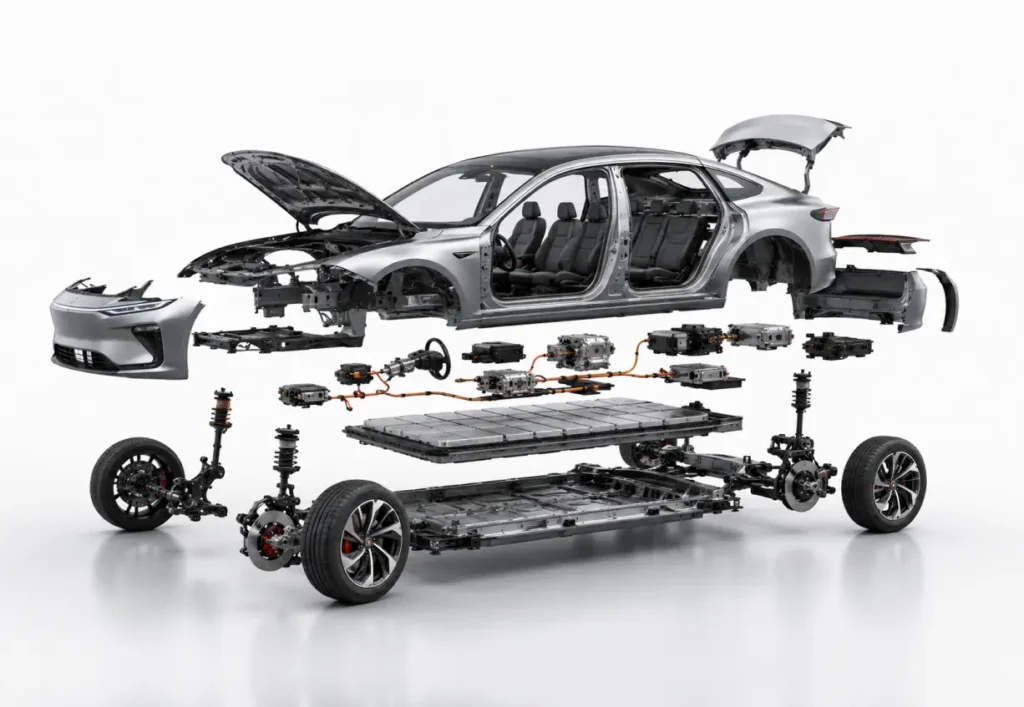
The major EV components are the traction battery pack (with integrated BMS), electric traction motor, power inverter, controller, onboard charger, charge port, DC/DC converter, thermal management system, regenerative braking system, Electronic Control Unit (ECU), and auxiliary battery. Together these systems form the complete electric vehicle architecture.
Q2. What is the most stolen EV component?
The traction battery pack and copper wiring from charging infrastructure are the most frequently targeted. Catalytic converters, the high-value theft target in ICE vehicles, are not present in BEVs, but high-value lithium battery packs and copper-intensive charging hardware have attracted theft in markets with high EV density.
Q3. Which component is most important in an electric vehicle?
The traction battery pack and specifically the Battery Management System within it is the most critical component. It determines vehicle range, safety, performance, and longevity. A well-engineered BMS is the difference between a battery that lasts ten years and one that degrades unpredictably within three.
Q4. What is the most expensive part of an EV?
The traction battery pack accounts for 40–50% of total vehicle cost. For passenger cars, this represents ₹3–15 lakh depending on pack size and chemistry. The power inverter is typically the second most expensive single component in the drivetrain assembly.
Q5. What are the 4 core components of an EV?
The four foundational EV components are: the traction battery pack (energy storage), the electric traction motor (propulsion), the power inverter (AC/DC conversion for the motor), and the controller (system intelligence and power management). All other components support, protect, or optimise these four.
Q6. What are the 7 parts of an electric motor?
The seven primary parts of an electric traction motor are: the stator (stationary winding that generates the magnetic field), rotor (rotating element that responds to the magnetic field), permanent magnets or rotor windings, shaft (transmits mechanical torque to the drivetrain), bearings (support the shaft and enable rotation), housing or casing (structural enclosure and thermal interface), and the resolver or encoder (position sensor that feeds rotor angle data to the inverter controller for precise torque management).