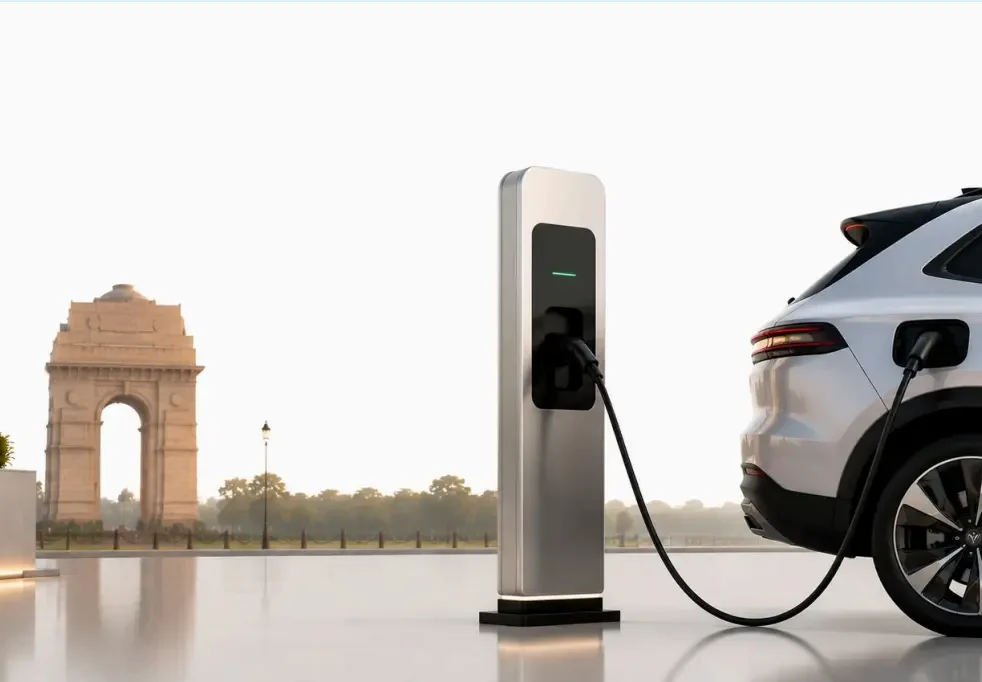
India had 27,737 public EV charging stations installed as of March 2026, of which 22,753 were operational. Against a vehicle fleet of over 5 million EVs, that’s a significant gap and closing it is one of the largest infrastructure opportunities in the country right now.
For developers, fleet operators, and OEMs, the question isn’t whether to invest in EV charging infrastructure. It’s how to do it right, the right charger type, the right site, the right certifications, and the right financial model. This guide covers all of it.
Why EV Charger Infrastructure Is Growing Rapidly in India
Rising EV Adoption Across Passenger and Commercial Segments
India registered over 2.3 million EVs in 2025. Two-wheelers lead the fleet, but four-wheelers, electric buses, and commercial logistics vehicles are all scaling fast. Each segment demands a different charging specification which means infrastructure requirements are diversifying rapidly, not converging.
Government Policies Supporting EV Infrastructure
The PM E-DRIVE scheme replaced FAME-II in October 2024 with a total outlay of ₹10,900 crore, of which ₹2,000 crore is specifically earmarked for EV charging infrastructure targeting 72,000 new chargers across the country.
Critically, EV charging is a de-licensed activity under the Electricity Act 2003 meaning any individual or entity can operate a charging station without a specific electricity distribution licence, provided they follow technical standards and obtain standard DISCOM and electrical approvals. That single policy decision has dramatically lowered the barrier to entry for private developers.
Growing Demand for Home, Public, and Fleet Charging
EV charging demand is tripartite. Home charging stations serve individual owners charging overnight. Public charging networks serve commuters and highway travellers. Fleet depot infrastructure serves logistics companies, cab aggregators, and bus operators operating at a fundamentally different scale and reliability standard. A serious EV charging infrastructure play needs to be clear about which of these it’s building for, because the technical and financial requirements are very different.
Expansion of Smart EV Charging Networks
The Indian EV charging station market is expected to grow at a CAGR of 27–31% from 2026 onwards, reaching USD 2–3 billion by 2030. That growth is increasingly driven by smart charging capability, OCPP-compliant systems, dynamic load management, real-time monitoring, and renewable energy integration. Infrastructure built without these features today will require expensive retrofitting within three to five years.
What Makes a Good EV Charging Infrastructure Project?
Before site selection, before hardware procurement, before anything get these fundamentals right.
AC and DC Charging Capabilities
Match your charger type to your use case.
AC chargers (3.3 kW–22 kW) are the right choice for home charging, workplace installations, and any location where vehicles dwell for two or more hours. They’re cheaper to install and put less stress on the grid.
DC fast chargers (30 kW–350 kW) are for public highways, commercial properties with short dwell times, and fleet depots where turnaround matters. DC fast chargers cost ₹3–7 lakh per 60 kW unit with total project cost significantly higher once land, grid connection, and civil works are factored in.
Don’t default to DC fast charging because it sounds better. Match the power level to the dwell time and business model.
Smart Charging and Software Integration
Smart charging means OCPP 1.6 or 2.0.1 compliance, cloud-based charge management software, remote start/stop and diagnostics, and dynamic load balancing across multiple charge points. As per Ministry of Power and CEA guidelines, all new networked chargers must support OCPP 1.6J or 2.0.1 for backend communication.
For commercial and fleet deployments, smart charging is not optional; it’s what allows you to manage energy costs, monitor uptime, bill users, and report to stakeholders.
Safety Certifications and Compliance Standards
Every charger deployed in India must carry BIS certification and IS 17017 compliance as a baseline. For DC fast chargers under PM E-DRIVE, CCS2 compatibility for four-wheelers is mandatory. Compliance requirements also include a DISCOM connection approval, Electrical Inspector sign-off before energising, and a Fire Safety NOC.
For OEM-integrated chargers, ARAI or iCAT certification applies. Build your procurement checklist around test reports not product brochures.
Scalability for Commercial EV Charging Projects
Think ahead. A modular charger architecture where power modules can be added to a single dispensing cabinet as demand grows costs more upfront but avoids a full hardware replacement when your site’s EV load doubles in two years. Plan your transformer sizing and switchgear with headroom for growth, not just current load.
OCPP Compatibility and Remote Monitoring
OCPP compliance means your chargers can talk to any OCPP-compatible charge management system, not just the one your hardware vendor sells. This matters enormously for large deployments where vendor lock-in is a real operational and commercial risk.
Types of EV Chargers for Infrastructure Deployment
AC EV Chargers
Single or three-phase AC chargers suitable for home, workplace, and retail parking installations. Low infrastructure cost, low grid impact per unit. Best where vehicles dwell for extended periods.
DC Fast Chargers
Bypass the vehicle’s onboard charger and deliver DC power directly to the battery. 30 kW to 350 kW. The right choice for public highways, commercial hubs with short dwell times, and any application where charging speed is the business case.
Portable EV Chargers
Compact, deployable units that remove dependence on fixed infrastructure. Relevant for fleet operators serving areas where grid-connected infrastructure is still sparse, or as a transitional solution while permanent infrastructure is being established.
Home EV Charging Stations
Dedicated EVSE (Electric Vehicle Supply Equipment) for residential installation. Typically 3.3 kW to 7.4 kW. Smart home chargers with scheduled charging and app control are now the expected standard, not a premium add-on.
Commercial EV Charging Stations
Multi-point installations at malls, office parks, hotels, and parking facilities. Typically a mix of AC chargers for longer-stay visitors and DC fast chargers for quick top-up users. Require load management to control demand charges.
Fleet and Bus Depot Charging Systems
High-throughput overnight charging for commercial EV fleets. Requires careful transformer sizing, load scheduling, and integration with energy management systems. Uptime is non-negotiable: a depot charger going down means a vehicle is out of service.
EV Charging Standards and Connector Types in India
Getting the connector standard wrong means a charger that can’t serve the vehicles at your site. Here’s the current picture.
CCS2 Chargers
For anyone with a four-wheeler EV in India in 2026, the connector picture is straightforward: Type 2 for AC charging and CCS2 for DC fast charging. CCS2 is the government-mandated standard for all new public DC fast chargers for passenger vehicles. Build any new public DC charging infrastructure to CCS2.
Type 2 AC Chargers
Type 2 (Mennekes) is the standard AC charging connector in India. It supports single-phase charging up to 7.4 kW and three-phase up to 22 kW. Every AC charger for four-wheelers in India uses Type 2. Straightforward and universal for passenger vehicle AC installations.
Bharat DC-001 Chargers
India’s domestic DC fast charging standard for two and three-wheelers. Supports up to 15 kW DC output. Bharat DC-001 is based on the GB/T protocol and remains the relevant standard for light EVs 4–5 times faster than basic AC charging for a two-wheeler battery. Any two or three-wheeler charging infrastructure needs Bharat DC-001 gun support.
GB/T Charging Standards
GB/T in India is now mostly limited to electric buses; many BYD and Olectra bus fleets use GB/T and some very early fleet vehicles. Not relevant for new passenger EV infrastructure, but necessary if you’re building a bus depot charging for Chinese-platform electric buses.
How to Choose the Right EV Charger Connector
Simple decision tree: Four-wheeler public DC charging → CCS2. Four-wheeler AC charging → Type 2. Two and three-wheeler DC fast charging → Bharat DC-001. Electric bus depot → confirm vehicle connector spec before ordering, as GB/T and CCS2 both exist in the Indian bus fleet. When in doubt, multi-standard hardware covers all bases at a modest cost premium.
Latest Trends in India’s EV Charging Industry
AI-Enabled Smart EV Charging
AI-based load forecasting and dynamic charging optimization are moving from pilot to mainstream. Smart systems predict peak demand periods, optimise energy procurement, and schedule charging sessions to minimise grid stress and energy cost simultaneously.
Solar-Powered EV Charging Stations
For fleet depots and commercial properties with significant rooftop area, solar-plus-storage plus EV charging is emerging as a financially viable model that reduces per-unit charging cost substantially. Several state EV policies now offer additional incentives for solar-integrated charging installations.
IoT-Based Charger Monitoring Systems
Real-time fault alerts, usage analytics, predictive maintenance scheduling, and energy management system integration are now standard expectations for commercial deployments. Running a public or fleet charging operation without remote monitoring is operationally untenable at scale.
Expansion of EV Charging in Tier-2 and Tier-3 Cities
The metro concentration is giving way to a second deployment wave. State policies in Tamil Nadu, Gujarat, Maharashtra, and Karnataka are actively subsidising charging infrastructure in smaller cities. Multiple states now require highways to have chargers every 25 km and urban areas to have one charger per 3×3 km grid.
Growing Demand for Fleet Charging Infrastructure
Fleet electrification is the fastest-growing segment in India’s EV charging market. Logistics companies, state transport undertakings, and cab aggregators are all converting at scale creating demand for high-throughput depot infrastructure that operates 24/7.
Common Challenges in EV Charging Infrastructure
Grid Load and Power Supply Limitations
Most commercial EV charging projects require a dedicated transformer or an upgrade to existing sanctioned load to prevent grid instability. Transformer capacity, feeder reliability, and distribution network quality determine site feasibility before a single charger is installed, especially in tier-2 cities and industrial zones where grid infrastructure is less robust.
EV Charger Downtime and Maintenance
Of 27,737 installed public chargers in India as of March 2026, only 22,753 were operational at an uptime rate of roughly 82%, below what commercial viability requires. Charger downtime is a direct function of hardware quality, software reliability, and after-sales support depth. It’s the single most important operational metric to track and manage.
High Setup and Infrastructure Costs
The charger hardware is often not the largest cost item. Grid connection upgrades, civil works, land costs, and permissions can easily exceed the hardware budget for DC fast charging installations. PM E-DRIVE’s 80% subsidy on upstream power infrastructure for qualifying sites significantly changes this equation for eligible projects.
Compatibility and Standardisation Challenges
India’s EV charging connector landscape is still fragmented. Multi-standard hardware eliminates compatibility risk but adds upfront cost. For new infrastructure, building to current government standards CCS2 for four-wheeler DC, Type 2 for AC, Bharat DC-001 for two-wheelers is the right approach.
Space and Parking Limitations
Dense urban environments present real installation constraints, limited bays, restricted civil modification permissions, and power infrastructure not designed for EV load. Basement and multi-storey car park installations require careful electrical design, ventilation planning, and specific earthing arrangements.
Government Support and Subsidies for EV Charging Infrastructure
Under PM E-DRIVE guidelines, government offices, residential colonies, hospitals, and educational institutions are eligible for a 100% subsidy on upstream infrastructure and EV charging equipment, provided they ensure free public access.
For commercial operators, the scheme provides tiered subsidies for highway corridor installations. Financial institutions like IREDA offer soft loans for EV infrastructure projects, and DISCOMs are mandated to expedite connections for new charging stations with special EV tariffs below standard commercial rates.
State-level schemes add to the central programme Maharashtra’s EV policy runs till 2030, Karnataka mandates EV charging provision in new commercial buildings, and Tamil Nadu has emerged as a manufacturing and deployment hub with its own incentive structure.
Future of EV Charging Infrastructure in India
Growth of Make in India EV Charging Solutions
India’s domestic EV charger manufacturing ecosystem has grown from a handful of certified players to 50+ manufacturers within five years. PLI-Auto incentives and import duty structures on charger components are creating sustainable manufacturing scale and reducing the hardware cost equation for infrastructure developers.
Expansion of DC Fast Charging Corridors
PM E-DRIVE targets 22,100 DC fast chargers for four-wheelers, 1,800 e-bus chargers, and 48,400 two and three-wheeler chargers as part of its national infrastructure programme. Highway corridor electrification is the next major build wave.
Rising Investments in EV Infrastructure
The Indian EV charging station market is valued at approximately USD 0.6–0.7 billion in 2026 and is projected to reach USD 2–3 billion by 2030. Private capital is following policy support: oil marketing companies, real estate developers, logistics companies, and dedicated charging network operators are all active investors.
Future-Ready Smart and Connected Charging
V2G (vehicle-to-grid), bidirectional charging, second-life battery integration at charging hubs, and AI-driven energy management are the next technology frontier. The infrastructure built today should be designed to accommodate these capabilities and not require complete replacement when they arrive.
Why Maxwell Energy for EV Charging Solutions
Advanced and Scalable EV Charging Hardware
Maxwell Energy’s EV charging products are built to the same automotive-grade standards as the BMS and motor control systems deployed across 550,000+ battery packs in 15+ countries. The 600W off-board charger certified to AIS 004 and ISO 26262, efficiency above 93%, IP65-rated is engineered for long operational lifetimes in real-world conditions.
Smart Technology and Energy Management
CC-CV charging algorithm, thermal management, earth leakage detection, surge protection, and advanced fault diagnostics are standard across Maxwell’s charger range. For fleet and OEM applications, this level of technical depth means a charging system that performs consistently across thousands of charge cycles.
Reliable After-Sales Support
Backed by Endurance Technologies’ manufacturing infrastructure and quality systems, Maxwell brings automotive-grade reliability standards to EV charging hardware. Zero field failures across 550,000+ BMS deployments is the benchmark the charging products are built to match.
Custom Development for OEMs
For OEMs with specific power, voltage, form factor, or certification requirements that off-the-shelf products can’t meet, Maxwell offers full custom charger development hardware design, embedded firmware, certification support, and production qualification under one roof.
Future-Ready Charging Capability
With multi-chemistry BMS expertise, motor controller development, and full custom power electronics capability, Maxwell is the technology partner for OEMs and developers thinking beyond the current product cycle, not just the current purchase order.
FAQs
Do I need a licence to set up an EV charging station in India?
No electricity distribution licence is required. EV charging is a de-licensed activity under the Electricity Act 2003. You do need a DISCOM connection approval, Electrical Inspector sign-off before energising, a Fire Safety NOC, and BIS-certified hardware. Networked chargers must also be OCPP 2.0.1 compliant.
What is the cost of setting up an EV charging station in India?
Home chargers: ₹8,000–25,000. Commercial AC chargers: ₹30,000–80,000. DC fast chargers: ₹3–7 lakh per 60 kW unit before upstream infrastructure costs. Total project cost for a public DC fast charging site can range from ₹15–50 lakh depending on grid connection requirements and civil works.
What government subsidies are available for EV charging infrastructure?
PM E-DRIVE provides up to 80% subsidy on upstream power infrastructure for qualifying highways and public locations. Government buildings and institutions qualify for 100% subsidy on equipment and infrastructure with free public access. IREDA soft loans are available for clean energy projects including EV infrastructure.
Which connector standard should I install for new public charging infrastructure?
CCS2 for four-wheeler DC fast charging. Type 2 for AC charging. Bharat DC-001 for two and three-wheeler DC fast charging. GB/T only if serving Chinese-platform electric bus fleets specifically.
What is OCPP and why does it matter?
OCPP (Open Charge Point Protocol) is the international communication standard between chargers and charge management systems. OCPP-compliant chargers can connect to any compatible software platform giving you vendor flexibility and preventing expensive lock-in. All new networked chargers in India are required to support OCPP 1.6J or 2.0.1.
Are EV charging stations profitable in India?
Increasingly yes particularly for fleet depots and commercial properties with predictable utilisation. ROI depends heavily on utilisation rate, tariff structure, CapEx including grid costs, and operating model. Realistic utilisation of 40%+ makes the economics viable for well-sited commercial installations.
What is the difference between AC and DC EV chargers?
AC chargers use the vehicle’s onboard charger to convert AC power to DC slower (3.3–22 kW) and cheaper to install. DC fast chargers bypass the onboard charger and deliver DC power directly to the battery faster (30–350 kW) but significantly more expensive in hardware and infrastructure cost.
How do I manage grid load at a large charging installation?
Dynamic load management through your charge management software distributes available power across all active charging sessions preventing demand spikes that trigger higher tariff rates or trip breakers. Modular charger designs and smart scheduling further reduce peak grid demand. For very large installations, BESS integration provides buffer capacity that reduces peak grid draw.
What smart features should modern EV chargers have?
OCPP compatibility, remote monitoring and diagnostics, scheduled charging, dynamic load balancing, fault alerts, usage reporting, and user authentication. For commercial deployments, payment integration and roaming capability through OCPI are increasingly expected.
Can a normal electrician install an EV charger?
A licensed electrical contractor can handle home charger installations. Commercial and DC fast charging installations require a qualified electrical engineer, proper earthing system design, CEA-compliant safety systems, and Electrical Inspector sign-off before the station can be energised.
What are the common EV charger installation problems in India?
Grid capacity limitations at the site, inadequate earthing systems, incorrect connector specification for the vehicle fleet being served, non-OCPP-compliant hardware creating software lock-in, and underestimating upstream infrastructure costs in the project budget.
Can a 22 kW charger charge a 7 kW EV?
Yes but it will only charge at 7 kW. The vehicle’s onboard charger limits the AC charging rate. Installing a 22 kW charger doesn’t damage the vehicle; it simply means you’re paying for infrastructure capacity the vehicle can’t currently use. Consider this carefully when sizing AC chargers for a fleet with mixed vehicle specifications.