
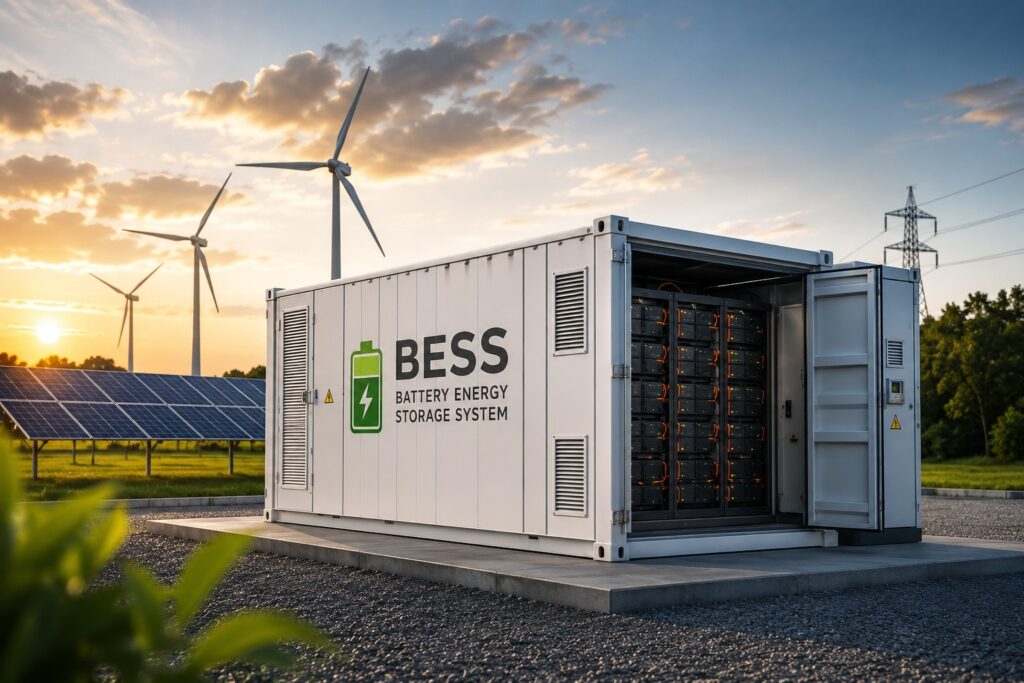
The world is generating more renewable energy than ever. The problem is timing. Solar peaks at noon. Demand peaks at 7pm. Wind blows at night. Factories need power at shift start. Battery Energy Storage Systems exist to close this gap capturing energy when it’s available and delivering it precisely when it’s needed.
A Battery Energy Storage System is an integrated technology platform that stores electrical energy in rechargeable battery modules, a system that uses chemicals to absorb and release energy on demand, making power available independently of when it was generated. It is the infrastructure layer that makes renewable energy reliable, grids stable, and energy economics manageable at every scale from a rooftop solar installation to a utility serving millions.
Why Battery Energy Storage Systems Matter
Core Benefits
Grid Stability: Power grids require instantaneous balance between generation and consumption. BESS provides fast-response regulation, reacting in milliseconds to frequency or voltage deviations that slower generation assets cannot track. A grid with adequate battery energy storage is fundamentally more resilient than one without it.
Clean Energy Support: Renewable generation is variable by nature solar and wind produced when conditions allow, not when demand requires. BESS captures energy from different sources and stores it in rechargeable batteries for dispatch when generation is low and demand is high. Without storage, excess renewable generation is curtailed and wasted. With BESS, it’s captured, stored, and monetised.
Cost Savings: BESS reduces electricity costs through energy arbitrage charging when electricity is cheap and discharging when it’s expensive and through peak demand shaving that cuts maximum demand charges. For large commercial and industrial energy users, these savings are material, measurable, and often the primary business case for BESS investment.
Backup Power: BESS provides seamless backup power during grid outages, transitioning to island mode in milliseconds far faster than diesel generators can start. For critical facilities, this response time difference is the difference between uninterrupted operation and costly downtime.
Key Applications
Utility Grids: Large-scale BESS installations co-located with generation assets or substations provide grid operators with fast-response frequency regulation, voltage support, and dispatchable capacity that complements intermittent renewable generation across the transmission network.
Commercial Sites: Office parks, hospitals, data centres, hotels, and manufacturing facilities use BESS to reduce peak demand charges, optimise time-of-use tariff exposure, and provide backup power delivering financial returns that justify investment within 3–7 years in most Indian commercial tariff environments.
Remote Microgrids: Off-grid communities, island grids, and remote industrial sites use BESS as the storage backbone of diesel-replacement or renewable-hybrid microgrids reducing fuel consumption, improving power quality, and extending access to reliable electricity in locations where grid connection is economically or physically impractical.
How Does a Battery Energy Storage System Work?
Charging
The BESS charges when electrical energy is available from the grid, solar generation, wind, or another source. The Power Conversion System (PCS) converts incoming AC power to DC for storage in the battery cells or in DC-coupled systems, and receives DC directly from solar generation. The Battery Management System monitors every cell during charging, enforcing voltage and current limits, managing cell balancing, and communicating pack status to the Energy Management System, which determines when and how fast to charge based on tariff signals, SoC targets, and forecast data.
Storing
Once charged, electrical energy is held in the electrochemical structure of the battery cells, lithium ions stored in the anode material in lithium-ion systems. The BMS continuously monitors stored energy during idle periods tracking self-discharge, maintaining cell balance, and monitoring temperature. The system stores electricity for later use with minimal losses, typically achieving round-trip efficiency of 85-95% depending on chemistry and system design.
Discharging
When the EMS dispatches a discharge command triggered by peak demand, grid frequency deviation, high tariff period, or backup power requirement the PCS converts DC from the battery cells back to AC for delivery to the load or grid. The BMS manages the discharge process cell by cell, enforcing minimum voltage limits, managing thermal conditions, and reporting real-time state data to the EMS throughout the discharge event.
Main Components of a Battery Energy Storage System
Core Storage and Conversion
Battery Cells and Modules
The cells are the fundamental electrochemical units where energy is stored lithium-ion in most modern BESS applications. Individual cells are assembled into modules, modules into racks, and racks into the full battery system. Cell chemistry, format (cylindrical, prismatic, pouch), and module architecture determine the system’s energy density, cycle life, thermal characteristics, and total cost.
Power Conversion System (PCS)
The PCS is the bidirectional inverter that converts between AC (grid side) and DC (battery side) in both directions AC to DC during charging, DC to AC during discharging. PCS efficiency directly determines round-trip energy losses. Modern utility-scale PCS units achieve 97–98.5% conversion efficiency. The PCS also manages grid synchronisation, reactive power control, and islanding capability.
Transformers and Switchgear
Transformers step voltage up or down between the battery system’s operating voltage and the grid interconnection voltage. Switchgear provides the protection, isolation, and control switching needed to connect and disconnect the BESS safely from the grid. Together, these components form the grid interface layer of the BESS; they must be sized and specified to handle the system’s full rated power in both charge and discharge directions.
Control and Safety Systems
Battery Management System (BMS)
The BMS is the local intelligence of the battery pack monitoring individual cell voltage, current, and temperature in real time, enforcing protection thresholds, managing cell balancing, and estimating State of Charge and State of Health. In BESS applications, the BMS communicates with the EMS via Modbus or CANopen, providing the cell-level telemetry the EMS needs for system-level optimisation and receiving dispatch commands it executes within its safety envelope.
Energy Management System (EMS)
The EMS is the system-level optimisation and control platform sitting above the BMS and PCS, co-ordinating all BESS assets toward economic and operational objectives. It manages charge/discharge scheduling against tariff signals and market prices, co-ordinates renewable integration, provides fleet monitoring and reporting, and executes grid service participation strategies. The EMS transforms the BESS from passive hardware into an active, optimised energy asset.
Thermal and Safety Management
BESS thermal management encompasses the cooling and heating systems that maintain battery cells within their optimal operating temperature window typically 15–35°C for lithium-ion. Active liquid cooling is standard for utility and commercial BESS. Fire detection and suppression systems, gas detection for early thermal runaway identification, and container-level ventilation complete the safety layer. These systems work in co-ordination with the BMS, which commands thermal management actions based on real-time cell temperature data.
Types of Batteries Used in BESS
Lithium-Ion Batteries
LFP (Lithium Iron Phosphate)
LFP is the dominant chemistry in new BESS deployments globally as of 2026. Its exceptional thermal stability the iron-phosphate bond resists the exothermic decomposition that triggers thermal runaway in higher-nickel chemistries makes it the safest lithium-ion option for large-scale storage applications. Cycle life of 3,000–6,000 cycles, cobalt-free chemistry, and declining cell costs have made LFP the default choice for utility and commercial BESS. The tradeoff is lower energy density than NMC acceptable for stationary applications where weight is not a constraint.
NMC (Nickel Manganese Cobalt)
NMC offers higher energy density than LFP 150–220 Wh/kg at the cell level versus 120–160 Wh/kg for LFP making it relevant for BESS applications where footprint or weight is constrained. Higher thermal sensitivity than LFP requires more sophisticated thermal management. NMC’s role in new BESS deployments is declining as LFP’s cost and performance continue to improve, but it remains relevant in space-constrained applications and existing installations.
Flow Batteries
Vanadium Redox
Vanadium Redox Flow Batteries (VRFBs) store energy in liquid vanadium electrolyte tanks rather than solid electrode materials. Energy capacity is determined by tank size, power by the cell stack; the two can be scaled independently, which is a significant advantage for applications requiring large energy-to-power ratios. VRFBs can be discharged to zero SoC without degradation and offer essentially unlimited cycle life. The tradeoff is lower energy density and higher upfront cost than lithium-ion. Best suited for long-duration storage applications (4–12 hours) where lithium-ion’s cycle degradation becomes a disadvantage.
Low Fire Risk
Flow batteries carry significantly lower thermal runaway risk than lithium-ion chemistries; the aqueous electrolyte is non-flammable, and the electrochemical reactions do not generate the exothermic cascades that make lithium-ion fires difficult to extinguish. For applications in densely built environments or locations where fire risk carries high consequences, the inherently lower fire risk of flow batteries is a meaningful safety advantage regardless of cost premium.
Alternative and Legacy Batteries
Lead-Acid
The oldest rechargeable chemistry in commercial use. Low upfront cost and mature recycling infrastructure are the primary advantages. Energy density of 30–50 Wh/kg, limited cycle life (300–500 cycles), and heavy weight make lead-acid increasingly uncompetitive for new BESS deployments. It persists in small backup power applications and legacy UPS systems but is being systematically displaced by lithium-ion in new commercial and utility storage projects.
Sodium-Sulfur
Sodium-sulfur (NaS) batteries operate at high temperatures (300–350°C) and offer high energy density and long discharge duration making them historically suited to utility-scale applications. NaS has been deployed by utilities in Japan, the US, and the Middle East for peak shaving and renewable integration. The requirement for high operating temperature and associated thermal management complexity limits deployment flexibility and increases operational complexity compared to ambient-temperature lithium-ion systems.
Solid-State
Solid-state batteries replacing liquid electrolyte with a solid ionic conductor promise significantly higher energy density, faster charging, and inherently better thermal safety than conventional lithium-ion. Still in early commercial deployment in 2026, with mass-market BESS application expected in the early 2030s as manufacturing scales and costs reduce. The technology is the most-watched development in battery storage for both BESS and EV applications.
What Are Battery Energy Storage Systems Used For?
Renewable Energy Integration
Solar and wind storage: BESS captures excess solar generation during midday hours and excess wind generation during off-peak periods, storing it for discharge during evening demand peaks when renewable generation is low. This time-shifting of renewable energy is the core function that makes solar-plus-storage and wind-plus-storage viable as firm generation resources.
Reducing waste: Without storage, renewable generation that exceeds instantaneous grid demand is curtailed. BESS eliminates curtailment by absorbing excess generation, improving the economics of renewable projects and increasing the total renewable energy delivered to end users. In India, curtailment is an active and growing problem as solar capacity outpaces grid flexibility BESS is the engineering solution.
Grid Stability and Support
Frequency regulation: Grid frequency must be maintained within tight bounds in India, 49.95–50.05 Hz under normal conditions. BESS responds to frequency deviations in milliseconds injecting power when frequency drops (under-generation), absorbing power when frequency rises (over-generation). This primary frequency response is the highest-value grid service BESS provides, and the one where its speed advantage over conventional generation is most pronounced.
Peak shaving: BESS discharges during periods of peak system demand, reducing the peak load that transmission and distribution infrastructure must carry. At the system level, this defers costly grid infrastructure investment. At the facility level, it reduces maximum demand charges that can constitute 30–40% of a commercial electricity bill.
Backup and Local Power
Emergency power: BESS provides uninterruptible backup power for critical facilities, hospitals, data centres, telecoms infrastructure, emergency services transitioning to island mode in milliseconds when grid supply fails. Unlike diesel generators, BESS backup is instantaneous, emissions-free, and requires no fuel logistics.
Microgrids: In remote or island locations without grid access, BESS is the storage backbone of renewable-hybrid microgrids absorbing solar or wind generation, providing dispatchable power when generation is low, and managing load balance in an isolated system. BESS-enabled microgrids are replacing diesel-only power systems across India’s remote regions, reducing fuel costs by 40–70% in well-designed installations.
Domestic vs Grid-Scale Battery Energy Storage Systems
| Features | Domestic BESS | Grid-Scale BESS |
| Capacity | 3–30 kWh | 1 MWh–1 GWh+ |
| Location | Residential rooftop or basement | Utility substations, solar/wind farms, industrial sites |
| Primary Use | Self-consumption, backup power, bill reduction | Grid stability, renewable integration, wholesale market participation |
| Owners | Individual homeowners, housing societies | Utilities, IPPs, industrial corporates, BESS project developers |
Key Benefits of Battery Energy Storage Systems
Financial and Cost Benefits
Energy Arbitrage
BESS charges when electricity tariffs are low, typically off-peak hours or periods of high renewable generation and discharges when tariffs are high. In time-of-use tariff environments, the spread between off-peak and peak pricing creates a repeatable revenue or cost-saving opportunity with every cycle. For utility-scale BESS participating in wholesale electricity markets, arbitrage is the foundational economic model.
Peak Shaving
By discharging during peak demand periods, BESS reduces a facility’s maximum recorded demand, cutting the demand charge component of the electricity bill. For industrial and large commercial consumers in India, where demand charges can account for 30–40% of total electricity cost, peak shaving delivers some of the most immediate and quantifiable financial returns of any energy investment.
Maximized ROI
BESS can stack multiple revenue streams simultaneously arbitrage, peak shaving, frequency regulation, capacity market participation, and avoid infrastructure costs. A well-designed BESS project with an intelligent EMS captures all applicable value streams, maximising return on the capital investment across the asset’s 10–20 year operational life.
Reliability and Grid Support
Backup Power
Millisecond transition to island mode, no fuel dependency, no startup delay BESS backup power is categorically different from diesel generator backup in speed, reliability, and operating simplicity. For facilities where power interruption has direct financial or safety consequences, BESS backup capability justifies investment independently of any energy cost savings.
Grid Stability
Fast-response frequency regulation and voltage support from BESS improves grid stability for all users, not just the facility or project that owns the BESS. As renewable penetration increases and conventional spinning reserve decreases, BESS-provided grid services become increasingly critical to system reliability.
Deferred Infrastructure Costs
BESS can defer or avoid costly grid infrastructure upgrades by managing load locally, reducing peak demand on distribution feeders, providing reactive power support to maintain voltage, and absorbing local renewable generation that would otherwise require network reinforcement. For utilities and distribution companies, BESS as a non-wire alternative to infrastructure investment is an increasingly attractive proposition.
Environmental Impact
Clean Energy Integration
BESS enables higher levels of renewable penetration by resolving the timing mismatch between renewable generation and demand. Every megawatt-hour of storage capacity deployed supports a disproportionate increase in renewable generation capacity; the storage makes the renewable energy firm, predictable, and therefore fundable.
Reduced Emissions
By enabling renewable time-shifting and reducing dependence on peaking gas or diesel generation the most carbon-intensive generation assets on most grids BESS directly reduces grid emissions. In India, where coal still dominates baseload generation, storage-enabled renewable integration makes a measurable impact on the carbon intensity of electricity.
How Long Does a Battery Energy Storage System Last?
A well-designed lithium-ion BESS using LFP chemistry typically delivers 3,000–6,000 charge cycles before capacity degrades to 80% of rated capacity, the standard end-of-warranty threshold. At one full cycle per day, this translates to 8–16 years of operational life at 80%+ capacity. Many utility BESS projects are designed for 20-year project lives which is achievable with LFP through conservative depth of discharge management, good thermal management, and quality BMS oversight.
Operational life is not just a function of cycle count. Calendar aging degradation from time alone regardless of cycling also occurs, driven primarily by temperature. A BESS operating at consistently elevated temperatures will age faster than the cycle count alone predicts. This is why thermal management quality and operating temperature history are the two variables that most significantly determine whether a BESS asset reaches its design life or falls short of it.
Flow batteries offer effectively unlimited cycle life; their degradation mechanism is different from lithium-ion making them the preferred technology for applications requiring 20+ years of daily cycling without capacity degradation management.
Market Growth and Future of Battery Energy Storage
Market Size and Growth Drivers
Market Valuation: The global battery energy storage market was valued at approximately USD 35–40 billion in 2025 and is projected to exceed USD 100 billion by 2030, growing at a CAGR of approximately 20–25% driven by renewable energy mandates, declining cell costs, and increasing grid-scale storage procurement globally.
Renewable Integration: Every major economy has committed to renewable energy targets that require significant storage deployment. India’s 500 GW non-fossil target by 2030 and the associated grid flexibility requirements have placed BESS at the centre of the country’s energy transition planning, with the government mandating storage procurement alongside new renewable tenders.
Surging Demand: Beyond utility applications, commercial and industrial BESS demand is accelerating as tariff structures increasingly reward demand management, corporate sustainability commitments drive behind-the-meter storage investment, and falling BESS system costs improve project economics across a wider range of applications.
Technology and Regional Trends
Chemistry Dominance: LFP has decisively won the utility BESS chemistry contest. Its thermal safety advantage, cycle life, and rapidly declining cost driven by Chinese manufacturing scale have made it the default specification for new projects globally. NMC and NCA remain relevant in EV applications but are increasingly displaced by LFP in stationary storage.
Geographic Leadership: China dominates global BESS manufacturing producing the majority of lithium-ion cells and integrated BESS systems deployed worldwide. The US, Europe, and India are all pursuing domestic manufacturing programmes to reduce this dependency. India’s ACC PLI scheme is the primary policy mechanism for building domestic cell manufacturing capacity.
Future Outlook: Long-duration storage 8–24 hour discharge duration is the next major deployment wave, addressing the overnight and multi-day variability that 2–4 hour lithium-ion systems cannot resolve. Flow batteries, sodium-sulfur, compressed air, and pumped hydro are all competing in this space. Solid-state batteries will reshape the short-duration storage economics in the early 2030s.
Challenges of Battery Energy Storage Systems
Economic and Supply Chain Hurdles
High Capital Costs
Despite significant cost reductions utility-scale BESS system costs have fallen from above USD 1,000/kWh in 2015 to USD 150–250/kWh in 2026 upfront capital cost remains a barrier for many project developers, particularly in emerging markets where financing costs are higher and offtake certainty is lower. Project financing structures, government subsidies, and declining cell costs continue to improve the economics, but capital cost remains the primary barrier to faster deployment.
Material Scarcity
Lithium, cobalt, nickel, and manganese are critical materials with geographically concentrated production. Demand growth from both EV and BESS applications is creating supply pressure that drives price volatility. The industry’s shift toward LFP (cobalt-free) and the development of sodium-ion (lithium-free) chemistries directly addresses this dependency, but the transition takes time.
Supply Vulnerability
The concentration of lithium-ion cell manufacturing in China creates supply chain risk for BESS projects globally both from a geopolitical access perspective and from the logistics costs and lead times involved in international supply. Domestic manufacturing programmes in India, the US, and Europe are the strategic response, but building meaningful manufacturing capacity takes years.
Technical and Safety Concerns
Thermal Runaway
Thermal runaway in lithium-ion BESS is the most serious safety risk, a self-reinforcing exothermic reaction that can result in fire or explosion. Utility-scale lithium-ion fires are difficult to extinguish and can burn for days. Prevention through quality BMS design, thermal management, and operational discipline is the primary defence. Detection gas sensors, thermal cameras, and early warning BMS algorithms are the secondary layers. Suppression typically of water mist or inert gas systems is the last resort.
Capacity Degradation
All lithium-ion batteries lose capacity over time and cycling. For BESS operators with contracted energy delivery obligations, unexpected degradation creates a gap between contracted and actual deliverable capacity, a financial and reputational risk. Accurate degradation modelling, conservative initial sizing (typically 10–20% overbuild), and SoH monitoring through the BMS are the standard engineering responses.
Management Failures
A BESS without adequate BMS and EMS integration is a significant liability. Poor BMS calibration leads to inaccurate state estimation, which leads to protection trips or, worse, undetected abuse events. Poor EMS configuration leads to suboptimal dispatch that either under-utilises the asset or damages it through inappropriate cycling. The control and management systems are not auxiliary to the BESS; they determine its safety, longevity, and economic performance.
Environmental and Grid Integration Issues
Recycling Gaps
Lithium-ion battery recycling infrastructure is not yet scaled to handle the volume of batteries reaching end-of-life from both EV and BESS applications. Recovery rates for lithium, cobalt, and nickel are improving but remain well below what is needed to close the material loop. Regulatory frameworks for BESS end-of-life management are still developing in most markets including India.
Grid Complexities
Connecting large BESS systems to the grid involves protection co-ordination, power quality management, islanding detection, and grid code compliance requirements that vary by jurisdiction and utility. Fast-responding BESS can interact with existing grid protection systems in unexpected ways requiring careful engineering of the grid interconnection and, in some cases, additional filtering or control system tuning.
How Battery Energy Storage Projects Are Deployed
Project Planning and Site Design
Site selection: BESS site selection balances grid connection cost (proximity to the interconnection point), land cost and availability, environmental permitting requirements, security and access considerations, and thermal management requirements (ambient temperature and cooling infrastructure availability). For co-located solar-plus-storage projects, the BESS site is typically adjacent to the solar plant.
Permitting and safety: BESS projects require electrical installation permits, fire safety clearances, environmental approvals, and grid connection agreements. In India, CEA electrical safety regulations, BIS equipment certifications, and DISCOM interconnection requirements all apply. Safety documentation, fire risk assessment, emergency response plans, and battery system safety data is required before commissioning.
Battery choice: Chemistry selection (LFP for most new projects), cell format (prismatic dominates utility BESS), system voltage, and discharge duration are the primary technical specifications determined at the planning stage. These decisions cascade into PCS sizing, transformer specification, thermal management design, and BMS requirements.
Core Equipment Installation
Battery racks: Battery modules are installed in purpose-designed racks within fire-rated battery enclosures or containers. Rack installation includes mechanical assembly, inter-module bus connections, BMS wiring harnesses for voltage and temperature sensing, and thermal management connection. Container-based BESS systems arrive factory-assembled and pre-commissioned, significantly reducing field installation complexity.
Inverters (PCS): The PCS is installed and connected to both the DC battery bus and the AC grid interconnection bus. PCS commissioning includes DC and AC safety verification, insulation resistance testing, and grid synchronisation testing before live operation. For multi-PCS systems, parallel operation co-ordination is verified during commissioning.
Transformers and switchgear: Grid-side transformers and medium-voltage switchgear are installed and tested to utility standards. Protection relay settings are co-ordinated with the distribution network operator to ensure correct fault isolation behaviour. Anti-islanding protection is verified before grid connection is approved.
Control and Grid Integration
BMS (Battery Management System): The BMS is configured with chemistry-specific protection parameters, communication addresses, and state estimation calibration. BMS communication to the EMS layer is verified confirming that SOC, SOH, temperature, fault status, and available power data flow correctly and that EMS dispatch commands are received and executed within the BMS safety envelope.
EMS (Energy Management System): The EMS is commissioned with site-specific dispatch modes, tariff schedules, and operational constraints. Integration with grid signals, renewable generation data sources, and utility SCADA is tested. Optimisation algorithm parameters are configured for the specific application peak shaving setpoints, arbitrage windows, frequency regulation response parameters.
Testing and commissioning: Full system commissioning includes capacity testing (verifying rated energy delivery), protection system testing (confirming all fault responses operate correctly), grid code compliance testing (verifying power quality, frequency response, and anti-islanding behaviour), and integrated EMS-BMS operation testing under simulated operational scenarios before the system is handed over for commercial operation.
Why Choose Maxwell Battery Energy Storage Solutions?
Core Technology and Performance
Limp Mode Operation
Maxwell’s BMS architecture supports limp mode operation when individual cells or modules develop faults, the BMS isolates the affected elements and continues operating the remaining healthy capacity rather than shutting down the entire system. For commercial and utility BESS where availability is a contractual and revenue obligation, this capability directly protects uptime and financial performance. A fault that would cause a full system shutdown in a conventional BMS causes a partial capacity reduction in a Maxwell system where the asset stays online.
Inter-circulating Current Prevention
In BESS installations with multiple battery packs operating in parallel, voltage and SoC differences between packs create circulating currents flowing between packs rather than serving the load. These circulating currents waste energy, stress cells, and accelerate degradation in the lower-voltage pack. Maxwell’s BMS for high-power systems actively prevents inter-circulating currents through dynamic parallel management, protecting all parallel-connected packs and maintaining efficient system operation.
High-Efficiency Converters
Maxwell’s power electronics are engineered for efficiency at the operating points that matter for BESS applications: partial load operation during frequency regulation, high-current discharge during peak shaving events, and continuous float operation during standby. High efficiency across the full operating range, not just at rated power, is what determines real-world energy losses and system economics over the asset’s operational life.
Safety and Intelligence
Flexible Chemistry Support
Maxwell BMS solutions support LFP, NMC, NCA, and NiMH chemistries across a voltage range of 24V to 1500V with 300+ configurable parameters that allow precise calibration for any cell chemistry and pack architecture. For BESS developers managing projects with different cell specifications, Maxwell’s chemistry flexibility eliminates the need for multiple BMS platforms across the portfolio.
Data-First Monitoring
Maxwell BMS platforms provide comprehensive telemetry individual cell voltage, temperature, current, SoC, SoH, fault history, and cycle count to the EMS layer in real time. This data density enables the EMS to make genuinely informed dispatch decisions rather than operating on pack-level averages that mask cell-level variation. For predictive maintenance and fleet management, the granularity of Maxwell’s monitoring data is what makes meaningful analytics possible.
Scalable Architecture
Maxwell’s modular BMS architecture scales from small commercial BESS installations to multi-MWh utility systems without architectural redesign adding modules, racks, and strings under a consistent master-controller structure. As BESS projects expand over time, Maxwell’s scalability means the control system grows with the asset rather than requiring replacement. As a leading BMS manufacturer in India, Maxwell Energy develops these battery management solutions for applications spanning energy storage, electric mobility, and industrial systems.
FAQs
Q. What are battery energy storage systems?
A Battery Energy Storage System is a system that stores electrical energy in rechargeable batteries capturing energy from the grid, solar, wind, or other sources and releasing it on demand. BESS combines battery cells, a Power Conversion System, a Battery Management System, and an Energy Management System into an integrated platform for energy storage, optimisation, and grid interaction.
Q. Why are people against BESS?
Opposition to BESS installations typically focuses on fire safety concerns; lithium-ion battery fires are difficult to extinguish and have occurred at utility-scale installations siting concerns (visual impact, land use, proximity to residential areas), and noise from cooling systems. These concerns are legitimate and are addressed through proper site selection, fire suppression system design, container-level safety architecture, and community engagement during project development.
Q. How long do BESS batteries last?
LFP-based BESS typically delivers 3,000–6,000 cycles before capacity falls to 80% translating to 8–16 years at one cycle per day. With conservative depth of discharge management and good thermal management, 20-year project lives are achievable for LFP BESS. Flow batteries offer effectively unlimited cycle life with periodic electrolyte maintenance.
Q. What is the cost of BESS in India?
Utility-scale BESS system costs in India range from approximately ₹3–5 crore per MWh in 2026, depending on system size, chemistry, integration complexity, and grid connection requirements. Commercial and behind-the-meter systems typically cost more per kWh due to smaller scale and higher integration complexity. Government subsidies and SECI tenders are improving economics for qualifying projects.
Q. What are the 4 types of energy storage?
The four primary energy storage categories are electrochemical (batteries lithium-ion, flow, lead-acid), mechanical (pumped hydro, compressed air, flywheels), thermal (molten salt, ice storage, phase change materials), and electrochemical capacitors (supercapacitors). Battery energy storage systems fall within the electrochemical category and are the fastest-growing storage technology segment globally.
Q. What are the risks of BESS?
Primary risks include thermal runaway and fire (mitigated through BMS design, thermal management, and fire suppression), capacity degradation over time (managed through conservative sizing and operating protocols), grid integration complexity (addressed through proper protection co-ordination), supply chain risk for critical materials (mitigated through chemistry selection and supplier diversification), and regulatory and permitting risk in markets with evolving BESS frameworks. Well-engineered systems with quality BMS, EMS, and thermal management substantially reduce all of these risks.